
Belonging Across Cultures
Loveboat, TaipeiThis flow follows Ever from feeling alienated from Chinese culture to recognizing that identity can hold both her American upbringing and her inherited cultural connections.
increasing Bearing strength in each event
 decreasing
Bearing strength in each eventdecreasingAn Outsider at Home

Americanness and Distance
A Narrow Local World
Growing up in Ohio as one of very few Asian American students, Ever has learned to avoid drawing attention to her Asianness. At home, English dominates, while her parents use Mandarin to speak privately; Chinese school becomes an experience of correction and embarrassment rather than connection.
A Name She Does Not Use
Her Chinese name, Ai-Mei, belongs chiefly to family memory and her grandfather’s affection. Ever prefers the English name that she has made her own, and she thinks of her cultural background as something she can keep at a distance.
That distance is not a simple rejection of heritage. It reflects the pressures of being visibly Asian in one setting and feeling unfamiliar with Chinese language and practices in another, a split that the trip will make impossible to ignore.
A Crowd That Reflects Her

Recognition and Disorientation
An Unexpected Relief
When Ever reaches Chien Tan, the number of Asian American students around her is unlike anything she has known in Ohio. In the lobby, her Asian Americanness feels less conspicuous; for a moment, blending into the crowd is a relief.
The Twinkie Label
That comfort is unsettled when Sophie calls Ever a Twinkie, implying that she is culturally unfamiliar despite her appearance. Ever is surrounded by people who might share parts of her background, yet she still feels she does not know enough to belong without qualification.
The moment complicates the idea that belonging follows automatically from shared appearance. Ever must contend with both the safety of a larger community and the insecurity of being judged against a version of cultural knowledge she was never given the chance to develop.
Learning Through the Senses

Culture Beyond the Classroom
Experiences Before Fluency
Ever arrives fearing that she will be unable to communicate, but her encounter with Taiwan is not limited to language lessons. Markets, food, music, architecture, and crowded streets give her sensory experiences that do not depend on already knowing how to read every sign.
A Song Opens a Connection
Mei-Hwa shares Orchid Grass with Ever, and the song becomes a bridge between a cultural inheritance and a present relationship. Ever’s interest grows through listening and movement rather than through forced mastery; she begins to want more understanding, including enough Mandarin to follow what her parents say.
Her developing connection is neither instant expertise nor a tidy return to roots. It is a willingness to approach unfamiliar things with curiosity and to let other people share what matters to them.
Several Names, One Person

Belonging Without Choosing One Side
Mei-Hwa’s Example
Ever learns that Mei-Hwa has an Indigenous name and a Chinese name and likes both. Her identity does not require her to erase either connection: she is from Indigenous communities and is also Taiwanese.
Ever Reconsiders Herself
Ever recognizes a reversal of her own position. She has felt divided between an American life and a heritage she does not fully understand, while Mei-Hwa demonstrates that more than one identity can be lived at once, through names, family ties, music, and everyday choices.
Ever begins using Ai-Mei again without treating it as a replacement for Ever. The change matters because she no longer sees a choice between being American and acknowledging Chinese ancestry as the only possible way to define herself.
A Self That Holds Together
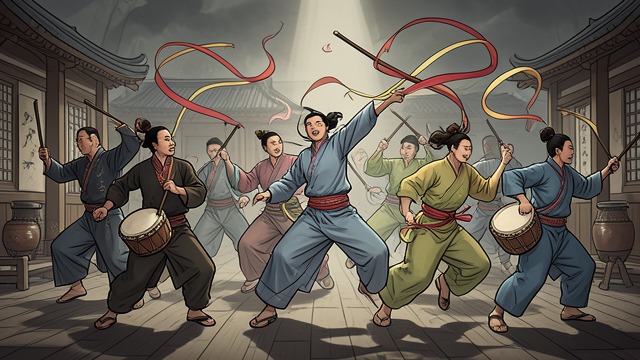
Integration in Motion
A Shared Stage
Ever’s original dance draws on Taiwanese music, group movement, ribbons, fans, drums, and staff fighting. Its form allows contrasting elements to meet without requiring them to become identical, making the choreography an expression of the kind of belonging Ever has been seeking.
Naming Her Own Identity
In the final movement, Ever understands that she can be glad to be partly Chinese and partly American while also being wholly herself. Her identity is not resolved by passing a test of cultural authenticity or by choosing one home over another.
The performance gives that insight a public form. Ever’s body, which earlier felt controlled by rules and scrutiny, becomes the medium through which she can hold complexity rather than hide from it.
Before Ever leaves Ohio
Upon arrival at Chien Tan
During the first weeks of the program
After Ever begins speaking with Mei-Hwa
At the final performance in Taipei
